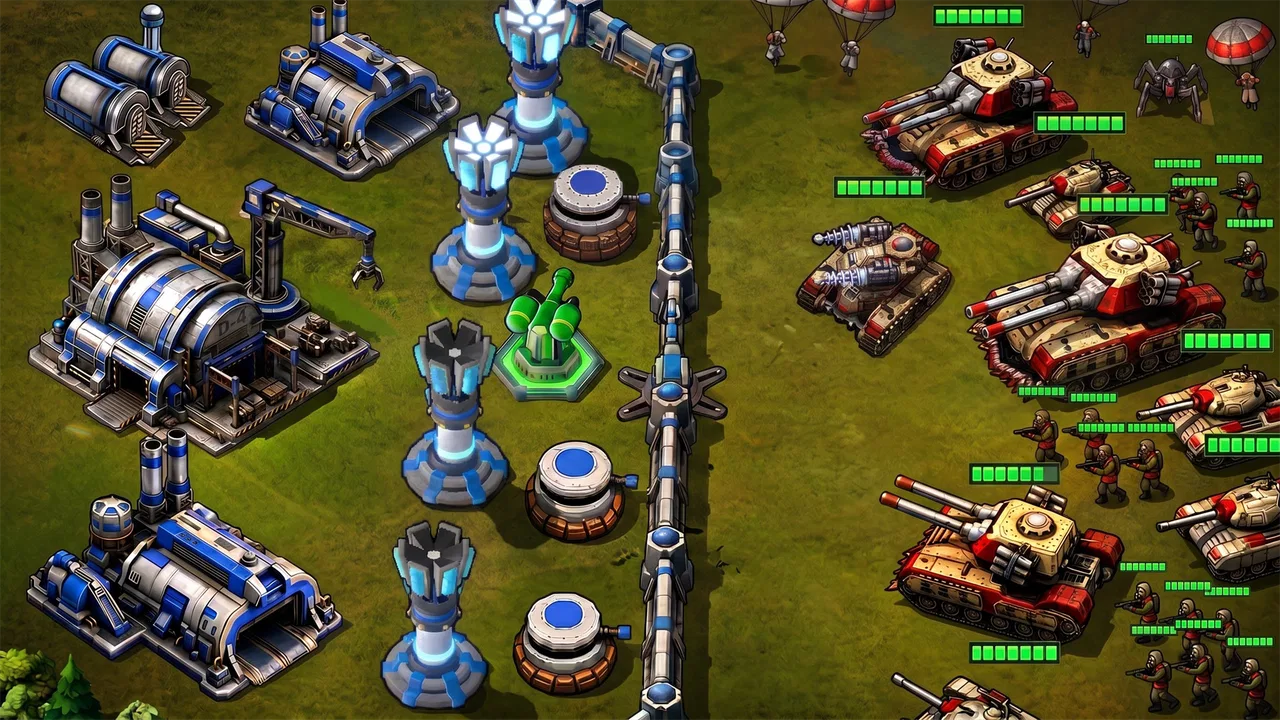
Red Command - War Alert RTS
- 4.7
- Rating
- 500.00K
- Installs
- Free
- Price

 Analysis by App-foxy
I spent time with Red Command - War Alert RTS as a compact strategy game built around battlefield decisions, unit improvement, and the steady pressure of taking territory. Its central appeal is easy to understand: you develop generals, make choices about your forces, and try to turn a difficult battle into a controlled advance. What surprised me is that the game is less about tapping quickly than about building a repeatable routine. The better results came from preparing before a fight, noticing where an upgrade would matter most, and resisting the urge to spend resources simply because they were available.
That makes it a good fit for players who enjoy classic war strategy without wanting a role-playing game overloaded with unrelated systems. It is free to start, carries a Teen content rating, and comes from TINYSOFT - slots, slot machines & casino games. The game has reached over 50 thousand installs and holds a 4.9 average from around 1.9 thousand ratings, which suggests that its focused approach has found an audience. I would still treat those figures as a starting point rather than a guarantee: the real question is whether you enjoy planning around upgrades and battlefield pressure.
Building a reliable battlefield routine
I use a simple routine to make each return to the battlefield easier to follow: decide what I want to learn, make one focused change, and then judge the result before changing course again. That approach also helps me notice whether the game’s presentation and pace still suit the moment, rather than pushing through when I’m tired or distracted. From there, it’s worth looking more closely at how readable and navigable the experience feels.
You May Also Like

 Blood Strike: 2.5 Anniversary
Blood Strike’s Loadouts Turn Every Drop Into a Tactical Gamble
A close look at Blood Strike’s custom loadouts: how fast access to signature weapons reshapes its battle royale rhythm, rewards preparation, and narrows the gap between fights.

 Pandora - Music & Podcasts
Pandora’s Music Is Easy to Start, but Harder to Recover
Pandora’s strength is its low-effort path from a seed to a station. Its weak spot is how much confidence it asks you to place in connection, setup, and quiet recovery.

 8 Ball Pool
 Is Built on Rivalries, Rematches, and Routine
A close look at the rivalries, rematches, shared routines, and unanswered safety questions that turn a quick pool match into a persistent mobile community.

 Samsung Music
’s Quiet Strength Is Playing What You Already Own
Its reach comes less from spectacle than from dependable access to a personal library. That simplicity is both the app’s strongest retention engine and its ceiling.

 AccuWeather: Weather Radar
AccuWeather Review: A Quick, Clear Forecast for Everyday Decisions
For everyday plans, the best forecast is the one you can understand quickly. AccuWeather makes rain timing, radar, and local conditions easy to act on, with a few trade-offs.

 Hill Climb Racing
Why Hill Climb Racing Still Turns Crashes Into One More Run
A tiny car, a bumpy hill and one more upgrade: Hill Climb Racing keeps resurfacing because its simple chaos makes every near-miss feel personal.
More From Our News Desk



What I do before committing to a battle
My most useful habit was separating preparation from action. Rather than entering every encounter immediately, I first looked at the state of my generals and considered which improvement would help in the next few battles. In a strategy game with a clear focus on commanding and upgrading, this small pause prevents a common mistake: spreading progress evenly across everything and ending up with a force that is adequate everywhere but strong nowhere.
I found it more practical to choose a main direction for a session. If I was trying to push through a difficult area, I concentrated on the general or capability that supported that goal. If I was simply playing for a short break, I avoided making expensive decisions and used the time to learn how the battlefield responded to my choices. This distinction matters because a quick session should not force a long-term commitment that you may regret later.
The basic loop is approachable, but it rewards attention. You are not just watching a battle unfold; you are trying to understand why one attempt worked and another stalled. I recommend treating each loss as a prompt to change one thing at a time. Alter the order of your decisions, improve a different general, or hold back a resource instead of changing everything at once. That makes the game easier to read and gives your progress a sense of direction.
A realistic short-session use case
For me, the game works well during a short commute or while waiting for an appointment, provided I already know what I want to accomplish. I might open it with one goal: strengthen the commander I rely on most, test a more cautious approach, or finish a particular stretch of progress. That is much better than opening it without a plan and spending the whole session reacting to prompts and upgrades.
Players who like to make a few meaningful choices and then check the result will probably feel comfortable here. Players who need constant direct control over every soldier may find the experience less satisfying. The emphasis is on strategic direction rather than the kind of detailed battlefield simulation where every individual movement can be managed manually.
How it differs from familiar strategy alternatives
Compared with large base-building games, this title feels more focused. There is less temptation to treat the game as a second job involving many timers, buildings, alliances, and layers of maintenance. That simplicity is a strength when I want a war-themed strategy session without a long checklist. The trade-off is that players who enjoy deep economic planning or a broad social layer may find the battlefield framework narrower than their preferred alternative.
It also differs from fast arcade war games. Success is not mainly about reflexes or rapid tapping. I got more from observing the relationship between general upgrades and battlefield outcomes. If you usually choose strategy games for their ability to reward patience, this is a better match than a game built almost entirely around speed. If you want immediate action with little preparation, the deliberate rhythm may feel slow.
Why the first few decisions matter
Early progress can create a misleading sense that every upgrade is equally valuable. My advice is to watch for the point where improvement begins to solve an actual problem. A general who helps you overcome a recurring obstacle is usually more useful than a minor increase that looks attractive but does not change your next battle. This is one of the less obvious lessons of the game: the best upgrade is not always the largest-looking one; it is the one that changes what you can reliably do.
I also avoided spending everything immediately after a successful battle. Keeping some flexibility made the next decision easier, especially when I was unsure whether the following challenge would expose a weakness. That habit is useful for free-to-play strategy games generally, but it feels particularly important here because the game invites you to think in terms of commanders and battlefield progression rather than casual one-off rounds.
Settings and practical checks
Before settling into longer sessions, I would check the available in-game settings and make sure the presentation feels comfortable on your device. The current version is 3.03.06, and the listed minimum operating system is Android 7.1. That broad compatibility makes it accessible to people using older Android hardware, although performance and comfort can still vary from one device to another.
I pay attention to sound and notification behavior first. A strategy game can become tiring if audio is too prominent in a quiet place, while a lack of sound can make a battle feel less readable when I am glancing at the screen. I also prefer to keep the interface as uncluttered as possible, because the important information is easier to process when decorative elements are not competing for attention.
Another setting-related habit is checking how purchases are presented before playing regularly. The game is free, with individual in-app purchases ranging from $0.99 to $99.99. I would not make a purchase simply because a difficult battle creates pressure. Instead, I would decide in advance whether I am comfortable spending anything and keep that decision separate from the emotion of losing.
Using a repeatable upgrade pattern
Experienced players will get more from a simple record of what they changed and what happened afterward. I do not mean a complicated spreadsheet. A short note such as “focused on the lead general, then tested the next battle” is enough to reveal whether an upgrade genuinely helped. This avoids the familiar trap of attributing every victory to the most recent purchase or improvement when several factors may have changed.
A useful pattern is to establish one dependable general before experimenting widely. Once I know which commander gives me a stable baseline, I can test another path without losing track of what reliable progress feels like. This is more efficient than constantly changing direction. It also makes the game less frustrating because a failed experiment becomes a temporary detour rather than a complete collapse of the plan.
I would also divide resources into three mental groups: what I need now, what I am saving for a clear upgrade, and what I can safely leave untouched. That last group is easy to ignore, but it protects me from impulsive decisions. A resource that is not spent immediately can preserve options for the next obstacle, which is often more valuable than a small improvement that does not alter the outcome.
Where faster play helps and where it hurts
There is a difference between playing efficiently and playing carelessly. Efficiency means entering a session with a target, checking the most relevant general first, and avoiding unnecessary detours. Carelessness means rushing through choices because the game is familiar. I found that the second approach creates more repetition, since a weak decision can force me to replay or rebuild progress that a short pause would have protected.
For repeated sessions, I would use the same opening routine every time: review the current objective, identify the most likely bottleneck, make one focused improvement, then test it. This routine is faster than browsing every option without a priority. It also makes the game easier to pick up after a day away because I am returning to a method rather than trying to remember a complicated sequence.
Shortcuts in a game like this are mostly mental rather than hidden buttons. Knowing where to look first, recognizing which general is central to your plan, and stopping before an unnecessary purchase are the real time-savers. I would be suspicious of any guide promising a secret trick that removes the need to understand the battlefield. The game’s strongest decisions come from reading your situation, not bypassing it.
Free access and the pressure of optional spending
The free entry point is helpful because it lets you discover whether the command-and-upgrade loop suits you before committing money. At the same time, the presence of purchases means self-control is part of the experience. I recommend playing long enough to understand the normal pace before deciding whether an optional purchase adds enjoyment or merely removes a moment of friction.
This is especially important for younger players because the Teen rating does not remove the need for careful purchase settings on the device. I would set a clear spending boundary before handing the phone to someone else, and I would avoid presenting purchases as the expected way to solve every difficult battle. The game is more satisfying when improvements feel connected to decisions rather than treated as automatic progress.
Limits that become clearer with experience
The focused design that makes the game approachable can also become its main limitation. If you want a large world with extensive diplomacy, detailed logistics, or a deep player-versus-player community, this may not provide enough breadth. Its appeal is the direct relationship between generals, upgrades, and battlefield progress. Once you understand that loop, you may start wanting more systems around it.
I also would not choose it for a completely passive experience. Even if a battle appears straightforward, the useful part is deciding how to prepare and what to change after the result. Players looking for something that can be left running in the background may find the strategic attention less rewarding. Conversely, players who enjoy learning from small adjustments will probably appreciate the compact scale.
Another limitation is the potential for upgrade decisions to feel repetitive if you prefer constant novelty. The game’s structure encourages refinement: improve a commander, test the effect, and adjust your next move. That is a good loop for mastery, but not necessarily for someone who needs a new mechanic every few minutes. I would choose a broader strategy title instead if variety is more important to me than a clear, repeatable battlefield routine.
Who should install it, and who should skip it
I would recommend it to someone who likes war-themed strategy games, wants a manageable session length, and enjoys seeing planning translate into stronger battlefield performance. It is also a sensible choice for players using an older Android device who want a strategy game with a low listed operating-system requirement. The free starting point makes experimentation easier, while the current version gives the game a defined, maintained-feeling package to try.
I would suggest skipping it if your ideal war game is primarily about realistic simulation, extensive army customization, or controlling every unit in a large-scale battle. I would also look elsewhere if in-app purchase pressure is likely to spoil the experience, even when the game can be started without paying. A more traditional premium strategy game may be a better fit for someone who wants a single upfront purchase and fewer spending decisions.
My verdict after settling into the loop
After playing it with a more disciplined routine, I came away with a favorable but measured opinion. Red Command - War Alert RTS is strongest when treated as a focused strategy exercise, not as a frantic war spectacle. Its best moments come from identifying a weakness, improving the right general, and seeing a previously difficult situation become manageable.
The 4.9 average from around 1.9 thousand ratings shows that many players respond positively to this formula, and I can understand why. The game is easy to approach, but it leaves room for better habits. I especially liked that efficient play came from preparation and restraint rather than from memorizing an elaborate system. That gives the title a practical appeal for short sessions and repeat visits.
My final recommendation is simple: try it if you want a free strategy game centered on battlefield advancement and commander upgrades, then give yourself time to learn its rhythm before spending anything. Keep one main upgrade path, change one variable when testing a new approach, and treat difficult encounters as information rather than invitations to buy a solution. With those habits, Red Command - War Alert RTS becomes a tidy, approachable war strategy game with enough decision-making to reward attention, while its limited scope and optional purchase structure remain important reasons for some players to choose a different alternative.
FAQs for Red Command - War Alert RTS
01What is the main objective of Red Command - War Alert RTS?
Red Command - War Alert RTS is a real-time strategy game where players must build and command their military forces to defeat opponents. The main objective is to strategize and outmaneuver your enemies through effective use of resources, tactical planning, and commanding troops to secure victory in various challenging missions.
02Is Red Command - War Alert RTS free to play?
Yes, Red Command - War Alert RTS is free to download and play. However, it offers in-app purchases that can enhance the gaming experience. These purchases typically include resources, special units, and upgrades, which can provide a competitive edge but are not necessary to enjoy the core gameplay.
03What platforms support Red Command - War Alert RTS?
Red Command - War Alert RTS is available on both Android and iOS platforms. Players can download the game from the Google Play Store for Android devices or the Apple App Store for iOS devices. Ensure your device meets the minimum system requirements for the best performance.
04Does Red Command - War Alert RTS require an internet connection?
Yes, Red Command - War Alert RTS requires a stable internet connection to play. This is necessary for accessing real-time multiplayer battles, updates, and syncing progress across devices. Some features may be available offline, but the core experience depends on being connected to the internet.
05Can I play Red Command - War Alert RTS with friends?
Absolutely! Red Command - War Alert RTS features a multiplayer mode where you can team up with friends or compete against other players worldwide. Form alliances, strategize together, and engage in epic battles to climb the leaderboards and dominate the battlefield.
Pros
- Engaging real-time strategy gameplay.
- Variety of units and tactics available.
- Smooth and intuitive user interface.
- Regular updates with new content.
- Multiplayer mode enhances replayability.
Cons
- In-app purchases can be pricey.
- Occasional server connectivity issues.
- Requires stable internet connection.
- Ads can be intrusive at times.
- Steep learning curve for beginners.

Red Command - War Alert RTS
Gallery